Essential Patient Monitoring Equipment Used in Modern Healthcare
Patient monitoring equipment plays an important role in hospitals, clinics, emergency departments, operating rooms, and intensive care units. These devices help healthcare professionals measure vital signs and observe changes in a patient’s condition. Depending on the equipment, monitoring may include heart activity, blood oxygen saturation, blood pressure, breathing rate, and temperature.
Selecting appropriate monitoring equipment requires an understanding of its purpose, available features, intended environment, and maintenance requirements. Knowing the differences between common devices can help healthcare facilities choose suitable products for their clinical needs.
What Is Patient Monitoring Equipment?
Patient monitoring equipment includes medical devices that measure, display, and sometimes record physiological information. Some devices provide a single measurement, while others combine multiple parameters in one system.
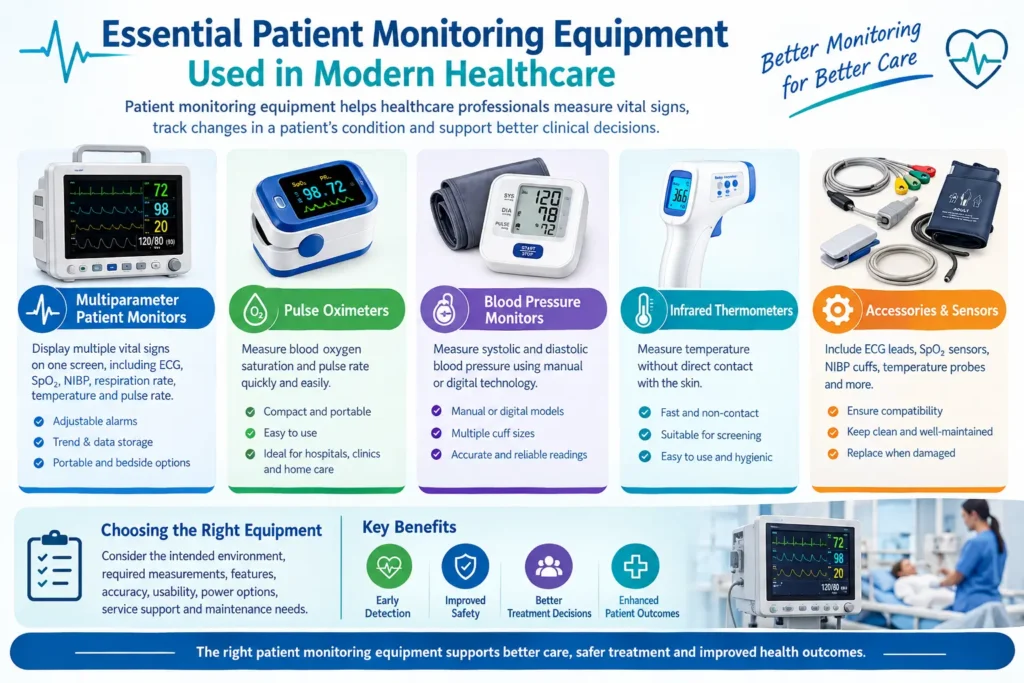
A pulse oximeter, for example, is typically used to measure peripheral blood oxygen saturation and pulse rate. A blood pressure monitor measures blood pressure, while an infrared thermometer measures temperature without direct skin contact. Multiparameter patient monitors can display several measurements on one screen.
Monitoring equipment supports clinical assessment, but readings must always be interpreted in context. A device does not replace professional examination, diagnosis, or clinical judgment. Healthcare staff should select and use each monitor according to the patient’s condition and the purpose of the measurement.
Multiparameter Patient Monitors
Multiparameter patient monitors are commonly used when healthcare professionals need to observe several vital signs together. Depending on the model and installed modules, these monitors may display electrocardiography (ECG), oxygen saturation (SpO₂), non-invasive blood pressure (NIBP), respiration rate, temperature, and pulse rate.
Many models include a digital display, adjustable alarm limits, trend information, and data storage. Portable versions can support monitoring during patient transfers, while larger systems may be used at bedsides or in critical care areas.
When selecting a multiparameter monitor, buyers should confirm which parameters are supported and which sensors or accessories are included. They should also consider display readability, alarm configuration, battery performance, connectivity, cleaning requirements, and staff training. Not every monitor includes all measurements, so product specifications should be checked carefully.
Pulse Oximeters for Oxygen Saturation
A pulse oximeter is a compact device designed to estimate blood oxygen saturation and measure pulse rate. Many models use a fingertip sensor and display the readings within seconds. Their portable design makes them convenient in hospitals, clinics, and appropriate home-care settings.
When choosing a pulse oximeter, important considerations include display visibility, ease of use, sensor suitability, battery life, and cleaning instructions. The device should be used according to the manufacturer’s directions because movement, poor circulation, sensor placement, and other factors can affect readings.
A pulse oximeter provides useful information but does not measure every aspect of respiratory function. Users should not rely on a single reading to make treatment decisions. Unexpected readings or concerning symptoms should be assessed by a qualified healthcare professional.
Blood Pressure Monitoring Devices
Blood pressure monitors are used to measure systolic and diastolic blood pressure. Manual sphygmomanometers generally use an inflatable cuff and pressure gauge, often together with a stethoscope. Digital blood pressure monitors automate parts of the measurement process and display the result electronically.
The cuff must be the correct size, and the device should be used with an appropriate technique to obtain reliable measurements. Healthcare facilities may select manual or digital models based on clinical practice, user training, frequency of measurement, and equipment requirements.
When buying a blood pressure monitor, consider the available cuff sizes, display, power requirements, ease of cleaning, and calibration or verification recommendations. Staff should follow the manufacturer’s instructions and applicable clinical guidelines.
Infrared Thermometers
Infrared thermometers measure temperature by detecting infrared energy emitted from a target. Non-contact models can measure temperature without touching the person’s skin, making them useful in settings where quick screening is needed.
Buyers should review the thermometer’s intended measurement site, measurement distance, accuracy specifications, operating range, and cleaning procedure. The device should be used according to the manufacturer’s instructions because incorrect distance, environmental conditions, or measurement technique can influence results.
An infrared thermometer is a temperature measurement tool, not a complete diagnostic system. Readings should be interpreted alongside symptoms and other relevant clinical information.
Choosing Equipment for Different Healthcare Settings
Different clinical environments have different monitoring requirements. Intensive care units and operating rooms may require multiparameter monitors with features selected for the procedures and patients being managed. General wards may need bedside monitors for routine observation. Ambulances and transport teams may need portable equipment that can operate on battery power.
Clinics may prioritize straightforward operation and equipment suitable for their patient population. Home-care equipment should be selected with guidance from healthcare professionals, who can explain how to use it and when readings require follow-up.
Before purchasing, assess the intended use, necessary measurements, compatibility of accessories, service availability, warranty conditions, and expected maintenance costs.
Maintenance and Staff Training
Reliable monitoring depends on more than the device itself. Sensors and cuffs must be used correctly, batteries need appropriate care, and equipment should be cleaned according to the manufacturer’s instructions. Devices should receive the recommended inspection, servicing, and calibration or performance checks where applicable.
Healthcare staff should understand the monitor’s limitations, alarm settings, measurement technique, and response procedures. Accessories should be compatible with the equipment, and damaged cables, sensors, or cuffs should be assessed before further use.
Conclusion
Patient monitoring equipment supports clinical observation by providing valuable information about vital signs. Multiparameter monitors, pulse oximeters, blood pressure monitors, and infrared thermometers serve different purposes and have specific operating requirements. By evaluating clinical needs, device features, accuracy considerations, usability, service support, and maintenance, healthcare facilities can make more informed purchasing decisions. Appropriate training and professional interpretation remain essential for safe and effective patient monitoring.