How to Choose the Right Hospital Bed for Patient Care
Choosing the right hospital bed is an important decision for hospitals, clinics, nursing homes, and home-care environments. A suitable hospital bed helps provide patient comfort, supports daily caregiving activities, and makes patient positioning more convenient. Different patients have different requirements depending on their medical condition, mobility, recovery needs, and duration of bed rest. Understanding the available hospital bed types and their features can help healthcare providers and caregivers make an informed decision.
Understanding Different Types of Hospital Beds
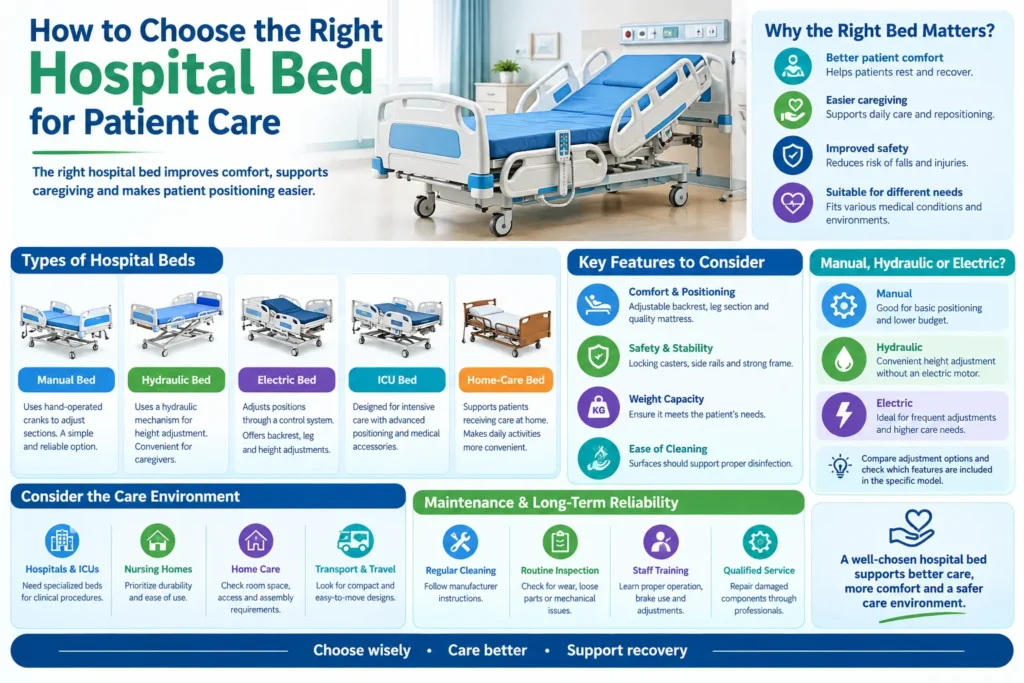
Hospital beds are available in several designs to accommodate different healthcare requirements. Manual hospital beds use hand-operated cranks to adjust the bed sections. They are a practical option for facilities that need a straightforward bed without electric adjustment. Hydraulic hospital beds use a hydraulic mechanism for height adjustment, helping caregivers position the bed conveniently.
Electric hospital beds allow users or caregivers to adjust selected bed positions through a control system. These beds may feature adjustable backrests, leg sections, and height settings, depending on the model. Electric ICU beds are designed for intensive care environments and may include additional positioning options and attachments for medical accessories.
Home-care beds are designed to support patients receiving care outside a hospital. They can help make routine activities, patient positioning, and caregiving more convenient. The right choice depends on the patient’s needs and the features required by the care provider.
Consider Patient Comfort and Positioning
Comfort is an important consideration when selecting a hospital bed, especially for patients who spend extended periods resting. An adjustable backrest can help patients sit more comfortably while eating, reading, or interacting with caregivers. Some beds also provide adjustable leg sections to support different resting positions.
The mattress is another important component. Foam mattresses provide cushioning and support, while specialized pressure-redistribution mattresses may be recommended for certain patients who have limited mobility or require prolonged bed rest. Mattress selection should be based on individual care needs and professional recommendations.
Side rails, where appropriate, may help provide support when patients reposition themselves. However, rails must be selected and used carefully because they are not suitable for every patient. Healthcare professionals should assess the patient’s mobility, condition, and specific safety requirements before deciding which features are appropriate.
Evaluate Safety and Stability Features
A hospital bed should have a stable structure and be suitable for the intended patient and care environment. Locking casters can help prevent unwanted bed movement when the bed is stationary. Side rails, locking mechanisms, and other safety components should be checked before use.
The bed’s maximum weight capacity must also match the patient’s requirements. Caregivers should confirm this information in the manufacturer’s specifications rather than estimating the bed’s capacity from its appearance.
Ease of cleaning is equally important in healthcare settings. Surfaces and upholstery should be compatible with the cleaning and disinfection products recommended by the manufacturer. Regular inspections can help identify wear, loose components, or mechanical issues that may affect safe operation.
Choose Between Manual, Hydraulic, and Electric Beds
Budget, frequency of use, and caregiving requirements can influence the type of bed selected. Manual beds may be suitable where basic positioning is sufficient and caregivers can operate the adjustment mechanisms. Hydraulic beds can provide convenient height adjustment without relying on an electric motor for that function.
Electric beds may be useful when frequent adjustments are required or when caregivers need to change the bed’s position efficiently. However, buyers should consider the power supply, control functions, maintenance needs, and availability of technical support.
Before making a purchase, compare the adjustment options and confirm which functions are included in the specific model. Product names alone do not always indicate the full range of available features.
Consider the Care Environment
The intended location plays an important role in bed selection. Hospitals and intensive care units may require specialized beds that accommodate particular clinical procedures and medical accessories. Nursing homes may prioritize durability, ease of operation, and routine patient-care requirements.
For home care, available room space, access through doorways, caregiver assistance, and the patient’s daily routine should all be considered. Buyers should also check whether the bed can be assembled and serviced at the intended location.
Maintenance and Long-Term Reliability
Regular maintenance can help preserve the condition and performance of a hospital bed. Follow the manufacturer’s instructions for cleaning, inspection, lubrication where applicable, and servicing. Electric and hydraulic mechanisms should be checked according to the recommended maintenance schedule.
Caregivers should receive instructions on operating the bed, using the brakes, adjusting the sections, and identifying possible faults. Damaged components should be assessed and repaired by qualified personnel rather than used without inspection.
Conclusion
Choosing the right hospital bed involves more than comparing prices. Patient comfort, adjustment features, safety, mattress compatibility, weight capacity, room requirements, and maintenance should all be considered. By evaluating these factors and consulting healthcare professionals when necessary, hospitals, care facilities, and families can select a bed that better matches their care requirements. A well-chosen hospital bed can make everyday patient care more convenient while supporting a comfortable and suitable care environment.